All published articles of this journal are available on ScienceDirect.

An Obesity Paradox in Atrial Fibrillation Recurrence after Cardioversion: Evidence From a Vietnamese Cohort

Abstract
Introduction
Predictors of Atrial Fibrillation (AF) recurrence after Direct-Current Cardioversion (DCCV) remain incompletely characterized in Southeast Asian populations. About 3 months of AF recurrence rate was evaluated, and clinical and echocardiographic factors associated with early recurrence were examined in a Vietnamese cohort.
Methods
This single-center observational cohort study included 96 patients with AF who underwent successful DCCV between December 2022 and April 2025 at the Tam Duc Heart Hospital in Vietnam. Baseline clinical, echocardiographic, and biochemical parameters were collected. The primary outcome was AF recurrence within 3 months. Multivariable logistic regression identified independent predictors. Model discrimination was assessed using receiver operating characteristic analysis.
Results
AF recurred in 39 patients (40.6%). Larger Left Atrial Diameter (LAD) was independently associated with recurrence (adjusted odds ratio [aOR] per 1 mm, 1.13; 95% CI, 1.03–1.25; p = 0.011), while higher Body Mass Index (BMI) was inversely associated (aOR per 1 kg/m2, 0.85; 95% CI, 0.74–0.99; p = 0.038). An integrative model (LAD, BMI, age) showed modestly improved discrimination versus LAD alone (AUC 0.73 vs. 0.62; p = 0.03).
Discussion
Larger left atrial size reflects structural remodeling and remains a consistent predictor of AF recurrence. The inverse association between BMI and recurrence may reflect a potential obesity paradox but should be considered hypothesis-generating given the modest sample size and possible residual confounding.
Conclusion
Larger left atrial size and lower BMI were independently associated with early AF recurrence after successful DCCV. A simple model incorporating LAD, BMI, and age may assist preliminary risk stratification but requires external validation before clinical application.
1. INTRODUCTION
Atrial Fibrillation (AF) is an increasing global health burden, with notable growth in Southeast Asia. Recent data indicate that Vietnam has experienced a nearly 7% annual rise in age-standardized Disability-Adjusted Life-Year (DALY) rates related to AF metabolic risk factors, the most significant increase globally [1]. According to the 2024 ESC Guidelines, the “AF-CARE” framework emphasizes rhythm control as central to improving patient prognosis [2]. However, this rapidly shifting epidemiological landscape necessitates rhythm control strategies tailored to the unique cardiovascular profile of the Vietnamese population [1, 3].
While Direct-Current Cardioversion (DCCV) is frequently used for sinus rhythm restoration, recurrence remains a clinical concern, affecting up to 55% of patients within 3 months [3]. Recent research has increasingly prioritized advanced imaging like left atrial strain and volumetric assessment for prognostic risk stratification [4, 5]. However, advanced echocardiographic measures may not be routinely available in resource-limited settings, whereas conventional Left Atrial Diameter (LAD) remains a simple and widely available echocardiographic measure. Previous studies have demonstrated an association between left atrial size and AF recurrence after successful cardioversion [4, 6, 7]. It remains unclear whether LAD retains sufficient prognostic utility for early recurrence in this specific demographic, characterized by distinct metabolic risks [1]. To address this gap, we evaluated the 3-month AF recurrence rate and investigated whether traditional parameters, specifically LAD, independently predict recurrence in this population.
2. METHODS
2.1. Study Design and Population
This single-center observational cohort study included consecutive patients with atrial fibrillation (AF) who underwent successful Direct-Current Cardioversion (DCCV) at Tam Duc Heart Hospital, Ho Chi Minh City, Vietnam, between December 2022 and April 2025. All participants were of Kinh ethnicity, with no participants from other ethnic groups. This period represents the eligible DCCV treatment period rather than the period of research-specific data collection. Clinical, echocardiographic, laboratory, treatment, and follow-up data were obtained from medical records generated as part of routine clinical care. Patients were assessed for AF recurrence during the 3 months following successful DCCV; consequently, follow-up of the last eligible patient extended through July 2025. No study-specific intervention was performed, and decisions regarding DCCV and subsequent clinical management were made independently by the treating physicians in accordance with the hospital's clinical guidelines.
No formal a priori sample-size calculation was performed because all consecutive eligible patients during the predefined study period were included. The resulting cohort of 96 patients is comparable in size to previous observational studies of AF recurrence after successful cardioversion that included approximately 76–99 patients [6, 8]. Eligible patients were aged ≥18 years and had documented AF requiring DCCV. Successful cardioversion was defined as restoration of sinus rhythm following the final shock with maintenance of sinus rhythm until hospital discharge. Patients were excluded if they had significant valvular heart disease, prior catheter ablation for AF, permanent AF, incomplete echocardiographic data, or insufficient follow-up information. DCCV was delivered using synchronized biphasic shocks under intravenous sedation, starting at 50 – 100 J and escalating to 150 J as needed. Anterolateral electrode placement was used, with one to two shocks delivered per procedure.
2.2. Data Collection and Baseline Assessment
Baseline demographic, clinical, and echocardiographic data were obtained from electronic medical records at the time of cardioversion. Collected variables included age, sex, Body Mass Index (BMI), AF type (paroxysmal, persistent, or long-standing persistent), CHA2DS2-VASc score, heart failure status, Left Ventricular Ejection Fraction (LVEF), and use of Antiarrhythmic Drugs (AADs) following cardioversion. Intravenous sedation was achieved with Propofol Lipuro 1% (titrated to 1–2 mg/kg) or thiopental 2.5% (initial dose, 2–3 mL), with adequate sedation confirmed by loss of verbal and pain responsiveness. Amiodarone was administered orally at 400 mg/day for 7 days, followed by 200 mg/day during the 3-month follow-up.
Blood samples for measurement of N-terminal pro–B-type natriuretic peptide (NT-proBNP) were obtained at baseline and at 3 months after cardioversion as part of routine clinical care using either the Elecsys proBNP II assay on Cobas e analyzers (Roche Diagnostics, F. Hoffmann-La Roche Ltd) or the Architect NT-proBNP assay on Architect/Alinity i platforms (Abbott Laboratories), according to routine laboratory procedures. Laboratory measurements were performed according to the hospital's routine standardized laboratory procedures.
2.2.1. Echocardiographic Assessment
Transthoracic echocardiograms were acquired with subjects in the left lateral decubitus position, and images were digitally recorded for offline analysis. To ensure temporal stability, measurements were obtained by averaging at least 3 consecutive cardiac cycles, in accordance with current American Society of Echocardiography guidelines. To minimize geometric error and ensure reproducibility, LAD was assessed using 2-dimensional (2D) echocardiography from the parasternal long-axis view. Measurements were timed at the left ventricular end-systole, corresponding to maximal LA size immediately prior to mitral valve opening. The anteroposterior diameter was measured at the level of the aortic sinuses of Valsalva using the leading edge–to–leading edge convention (from the leading edge of the posterior aortic wall to the leading edge of the posterior LA wall) [9]. This convention was utilized to ensure consistency with historical epidemiological datasets and established Vietnamese clinical practice standards. Intraobserver and interobserver variability for the 2D LAD measurement were assessed in a random subset of 15% of the cohort. Linear measurements demonstrated high reproducibility, with intraclass correlation coefficients of 0.92 for intraobserver and 0.90 for interobserver variability. All sonographers were blinded to clinical follow-up data and AF recurrence outcomes at the time of measurement.
2.3. Follow-up and Outcome Definition
Patients were followed for 3 months after confirmed successful cardioversion. The primary outcome was AF recurrence within 3 months after successful DCCV. We defined recurrence as any documented episode of atrial fibrillation lasting at least 30 seconds. These episodes could be captured on a 12-lead Electrocardiogram (ECG) or a 24-hour Holter ECG during the 3-month mark. We also counted recurrence at any point during follow-up if a patient felt symptoms like palpitations or an irregular heartbeat that suggested the arrhythmia had returned, confirmed by an ECG.
2.4. Statistical Analysis
Continuous variables are presented as mean (SD) for approximately normally distributed data and as median (IQR) for skewed distributions. Categorical variables are presented as counts and percentages. We used logistic regression to model the binary outcome of 3-month AF recurrence, as all patients successfully completed a 3-month follow-up without censoring and the time-to-event variation was negligible. Given 39 recurrence events, the multivariable model was restricted to four clinically relevant covariates (left atrial diameter, body mass index, age, and heart failure status) to reduce the risk of overfitting. For discrimination analysis, a parsimonious model comprising LAD, BMI, and age was retained because adding heart failure did not improve model fit or discrimination (likelihood-ratio p=0.239; DeLong p=0.954).
Model performance should therefore be considered exploratory. Results are reported as adjusted odds ratios (aORs) with 95% Confidence Intervals (CIs).
Post-DCCV Antiarrhythmic Drug (AAD) therapy was excluded from multivariable analysis because most patients were maintained on a homogeneous regimen of amiodarone (91.2% in the no-recurrence group vs. 87.2% in the recurrence group). Due to this lack of significant pharmacological variance between cohorts, AAD use was not considered a viable discrete predictor for the model.
Model discrimination was assessed using Receiver Operating Characteristic (ROC) curve analysis, and the Area Under the Curve (AUC) was calculated. Differences in AUC between nested models were compared using the DeLong test. The optimal LAD cutoff for identifying 3-month recurrence was determined by maximizing the Youden index; sensitivity and specificity at this threshold were reported. Calibration was assessed by comparing predicted and observed risks (including the Hosmer–Lemeshow goodness-of-fit test as a descriptive measure). Subgroup analyses were exploratory, and no formal adjustment for multiple comparisons was applied. Accordingly, subgroup findings were interpreted based primarily on interaction tests and should be considered hypothesis-generating. Effect modification was evaluated by including interaction terms in regression models, and p-values for interaction were reported. Change in NT-proBNP levels was analyzed using the Mann–Whitney U test and was considered exploratory.
All analyses were performed using R software (version 4.5.2). A two-sided p-value < 0.05 was considered statistically significant.
2.5. Ethics Statement
This cohort study was conducted at Tam Duc Heart Hospital. The study protocol was approved by the Institutional Review Board (IRB) of Tam Duc Heart Hospital (approval No. 30.24/GCN-BVTĐ; dated November 14, 2024). The study included routinely collected clinical records of patients who underwent DCCV between December 2022 and April 2025. December 31, 2022 represents the beginning of the eligible clinical-record period rather than the initiation of research-specific data collection. All clinical and follow-up information analyzed in this study was derived from medical records generated during routine clinical care. No study-specific intervention or modification of patient management was performed, and decisions regarding DCCV were made independently by the treating physicians in accordance with the hospital's clinical guidelines. This study is reported in accordance with the Strengthening the Reporting of Observational Studies in Epidemiology (STROBE) guideline.
3. RESULTS
3.1. Baseline Characteristics
Of 124 patients assessed for eligibility, 16 were excluded (11 did not meet inclusion criteria; 5 declined to participate), and 12 experienced failed DCCV. The final study cohort comprised 96 patients who achieved successful restoration of sinus rhythm following DCCV. There was no missing data for the primary variables of interest. At the 3-month follow-up, 57 patients (59.4%) remained in the non-recurrence group, while 39 (40.6%) experienced atrial fibrillation recurrence (Fig. 1).
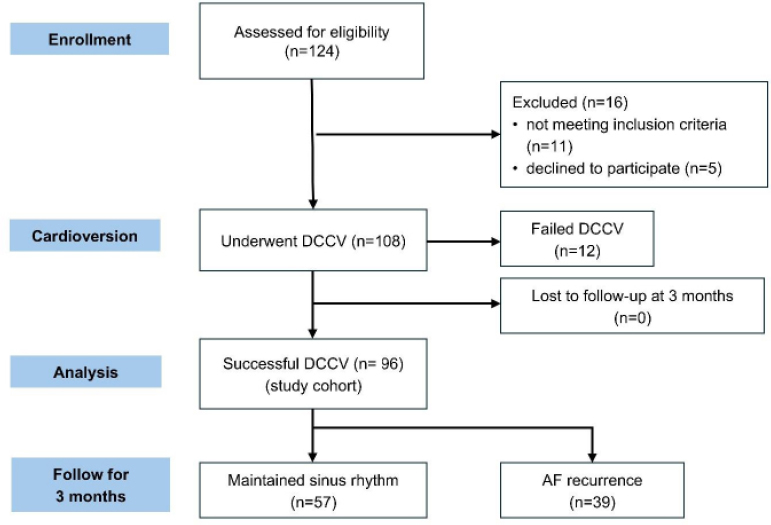
Abbreviations: (DCCV: direct-current cardioversion; AF: atrial fibrillation).
Baseline characteristics are summarized in Table 1. Patients who experienced AF recurrence were significantly younger than those without recurrence (59.2 {10.0} vs. 64.3 {12.6} years, p = 0.029). In addition, Left Atrial Diameter (LAD) was significantly greater in the recurrence group (42.6 {6.0} vs. 39.9 {4.9} mm, p = 0.021). No significant differences were observed between the two groups regarding sex distribution (female, 25.6 vs. 33.3%, p = 0.562), left ventricular ejection fraction (56.9 {11.5} vs. 59.5 {9.5} %, p = 0.251), body mass index (24.3 {3.5} vs. 25.3 {3.2} kg/m2, p = 0.140), or NT-proBNP levels (475 {296–854} vs. 400 {189–805} pg/mL; p = 0.160). Persistent AF was the most prevalent type. Antiarrhythmic Drug (AAD) utilization, primarily amiodarone, was high across the cohort (89.6%) and showed no statistically significant difference between those who maintained sinus rhythm and those who experienced recurrence (p = 0.638).
| Characteristic | No Recurrence (n=57) | Recurrence (n=39) | p-value |
|---|---|---|---|
| Demographics | |||
| Age, mean (SD), y | 64.3 (12.6) | 59.2 (10.0) | 0.029 |
| Male sex, No. (%) | 38 (66.7) | 29 (74.4) | 0.562 |
| Female sex, No. (%) | 19 (33.3) | 10 (25.6) | 0.562 |
| Height, mean (SD), cm | 164.1 (9.5) | 165.5 (7.5) | 0.412 |
| Weight, mean (SD), kg | 68.5 (12.4) | 66.7 (12.3) | 0.487 |
| Body mass index, mean (SD), kg/m2 | 25.3 (3.2) | 24.3 (3.5) | 0.140 |
| CHA2DS2-VASc score, median (IQR) | 3 (1-4) | 2 (1-3) | 0.073 |
| Clinical and Laboratory | |||
| Heart failure, No. (%) | 11 (19.3) | 13 (33.3) | 0.187 |
| NT-proBNP, median (IQR), pg/mL | 400 (189–805) | 475 (296–854) | 0.160 |
| Echocardiographic Parameters | |||
| Left atrial diameter, mean (SD), mm | 39.9 (4.9) | 42.6 (6.0) | 0.021 |
| LVEF, mean (SD), % | 59.5 (9.5) | 56.9 (11.5) | 0.251 |
| AF Clinical Type, No. (%) | 0.299 | ||
| Paroxysmal | 14 (24.6) | 7 (17.9) | |
| Persistent | 33 (57.9) | 20 (51.3) | |
| Long-standing persistent | 10 (17.5) | 12 (30.8) | |
| Post-DCCV Medication, No. (%) | 0.638 | ||
| Amiodarone | 52 (91.2) | 34 (87.2) | |
| Flecainide | 1 (1.8) | 2 (5.1) | |
| No AAD | 4 (7.0) | 3 (7.7) |
3.2. Multivariable Predictors of AF Recurrence
In multivariable logistic regression adjusted for age, BMI, and heart failure status, LAD remained independently associated with AF recurrence. Each 1-mm increase in LAD was associated with a 13% increase in the odds of recurrence (aOR 1.13; 95% CI, 1.03–1.25; p = 0.011). Each 1 kg/m2 increase in BMI was associated with a 15% reduction in the odds of recurrence (aOR per 1 kg/m2 increase 0.85; 95% CI, 0.74–0.99; p = 0.038). Age demonstrated a borderline inverse association with recurrence (aOR 0.96; 95% CI, 0.93–1.00; p = 0.051). Heart failure status was not independently associated with recurrence (p = 0.239) (Table 2).
| Predictor | Adjusted OR (95% CI) | p-value |
|---|---|---|
| Left atrial diameter (per 1-mm increase) | 1.13 (1.03–1.25) | 0.011 |
| Body mass index (per 1-kg/m2 increase) | 0.85 (0.74–0.99) | 0.038 |
| Age (per 1-year increase) | 0.96 (0.93–1.00) | 0.051 |
| Heart failure (yes vs. no) | 1.86 (0.66–5.21) | 0.239 |
3.3. Discriminative Performance of the Reduced Model
The AUC for LAD alone was 0.62 (95% CI, 0.50–0.74). In multivariable analysis, heart failure was not independently associated with 3-month AF recurrence (aOR 1.86, 95% CI 0.66–5.21; p = 0.239). A reduced model comprising LAD, BMI, and age was therefore evaluated for discrimination. This three-variable model yielded an AUC of 0.73 (95% CI, 0.62–0.83), reflecting modestly improved discrimination compared with LAD alone (p = 0.03). Calibration assessment using the Hosmer–Lemeshow test did not indicate significant lack of fit. The LAD cutoff derived from Youden index optimization (41 mm) showed moderate sensitivity and specificity and should be considered exploratory (Fig. 2).
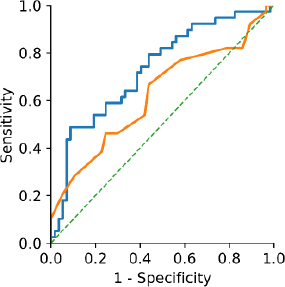
Receiver operating characteristic curves for predicting 3-month atrial fibrillation recurrence. The integrative model (solid navy line), incorporating left atrial diameter (LAD), body mass index (BMI), and age, demonstrated an area under the curve (AUC) of 0.73 (95% CI, 0.62–0.83). This performance was significantly superior to the model based on LAD alone (solid orange line; AUC, 0.62; 95% CI, 0.50–0.74; p = 0.03 by DeLong’s test). The dashed diagonal line represents the null hypothesis (AUC = 0.50).
3.4. NT-proBNP changes after Cardioversion
Exploratory analysis demonstrated a greater reduction in NT-proBNP levels over 3 months among patients maintaining sinus rhythm compared with those with recurrence (p = 0.010) (Fig. 3). This analysis was exploratory, not adjusted for potential confounders, and was therefore not included in the multivariable model.
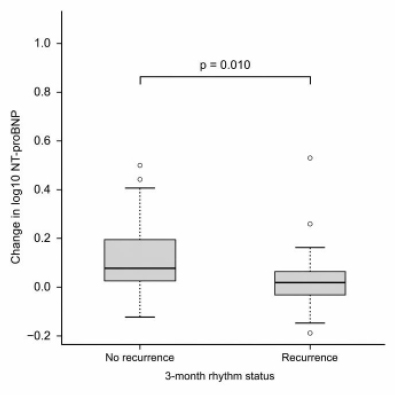
Change in NT-proBNP levels from baseline to 3 months according to rhythm status. Values are log10-transformed NT-proBNP levels (pg/mL). The boxplots indicate the median and Interquartile Range (IQR). The whiskers represent the 1.5 x IQR range, and individual observations are overlaid as jittered points; open circles indicate outliers. The p-value was calculated using the Mann-Whitney U test to compare the distributions of the log10-transformed change between patients with and without atrial fibrillation recurrence at 3 months.
3.5. Subgroup Analysis
The association between LAD and recurrence was directionally consistent across subgroups including sex, age (<65 vs. ≥ 65 years), AF type (paroxysmal vs. persistent/long-standing persistent), and heart failure status. Formal interaction testing did not demonstrate statistically significant effect modification by sex (Pinteraction = 0.85), age group (Pinteraction = 0.91), AF type (Pinteraction = 0.52), or heart failure status (Pinteraction = 0.22) (Fig. 4). Given the modest sample size and limited number of recurrence events, these subgroup analyses should be considered exploratory and interpreted with caution.
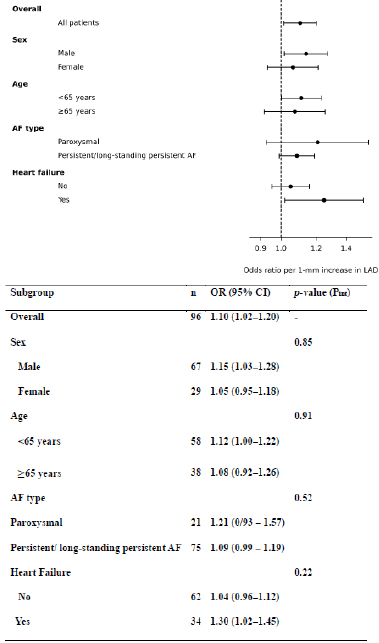
Association of Left Atrial Diameter (LAD) with Atrial Fibrillation (AF) recurrence across clinical subgroups. The forest plot displays the Odds Ratio (OR) and 95% CI for AF recurrence per 1-mm increase in LAD. Subgroup-specific estimates are represented by solid circles, with horizontal lines indicating the 95% CIs. The solid circle for “All patients” represents the overall OR. N indicates the number of patients in each subgroup. Pint denotes the formal P value for interaction, derived from multivariable logistic regression models including an interaction term between LAD and each subgroup variable to assess whether the association significantly differs across groups.
4. DISCUSSION
4.1. Principal Findings
This study cohort reflects a middle-aged to older population with a high burden of cardiovascular comorbidities, consistent with the reported rise in AF-related metabolic risk factors in Vietnam. The recurrence rate of 40.6% observed in our study underscores a significant clinical challenge. Larger LAD and lower BMI were independently associated with increased odds of recurrence. An integrative model incorporating LAD, BMI, and age demonstrated modest improvement in discrimination compared with LAD alone.
These findings reinforce the relevance of structural atrial remodeling in early rhythm instability after cardioversion, consistent with prior reports showing substantial recurrence rates even after initially successful cardioversion [3, 8, 10].
4.2. Left Atrial Diameter and Structural Remodeling
Patients with AF recurrence were younger and had a significantly larger left atrial diameter than those without recurrence. While the younger age observed in this cohort warrants further investigation, the association between left atrial enlargement and AF recurrence is consistent with atrial structural remodeling. Left atrial enlargement reflects chronic pressure and volume overload, atrial fibrosis, and electrical remodeling [9]. Meta-analytic evidence further supports the role of left atrial volume index as a strong predictor of recurrence [4]. Advanced echocardiographic parameters, including left atrial strain and mechanical dysfunction, provide additional prognostic value [5, 9]. Importantly, LA diameter remains a practical surrogate, with validation studies demonstrating its correlation with left atrial volume [11].
Structural remodeling alters atrial conduction properties and facilitates re-entry mechanisms that promote AF recurrence even after successful restoration of sinus rhythm. AF recurrence is influenced by complex clinical phenotypes rather than single parameters, as demonstrated by cluster-based analyses [12]. Early failure of rhythm control strategies may indicate a more advanced arrhythmogenic substrate and is associated with a higher likelihood of subsequent recurrence [13]. In the present study, LA diameter maintained an independent association with recurrence after adjustment for relevant clinical covariates, suggesting its continued utility for risk stratification. These findings indicate a graded increase in recurrence risk associated with increasing LA diameter. Although our analysis suggests a threshold of 41.0 mm, this value must be viewed as exploratory; this anatomical measurement likely represents a transition toward an arrhythmogenic substrate, requiring validation in larger, prospective, multicenter cohorts before guiding definitive clinical practice.
4.3. Body Mass Index and Recurrence Risk
The inverse association between BMI and AF recurrence in our Vietnamese cohort warrants cautious interpretation. While obesity is a well-established risk factor for incident AF, its relationship with post-cardioversion outcomes appears heterogeneous [1]. Our findings, which contrast with Western reports linking higher BMI to increased recurrence [10], align with prior observations in Asian populations, where a U-shaped association between BMI and AF outcomes has been proposed [14]. These discrepancies likely stem from limitations inherent in BMI as a crude surrogate for cardiometabolic risk. BMI fails to account for cardiometabolic risk, which is profoundly influenced by central adiposity, dietary habits, and physical activity [15]. Moreover, underlying metabolic dysfunction is driven by insulin resistance and systemic inflammation, mediated by markers such as WISP-1 and Fetuin-A [16, 17]. Lifestyle interventions, including aerobic exercise combined with fasting, have been shown to significantly mitigate these pro-inflammatory pathways and optimize body composition [16]. Therefore, the inverse relationship between BMI and AF recurrence observed in our study is likely confounded by unmeasured variables, such as visceral fat distribution, metabolic reserve, and inflammatory status, rather than reflecting a genuine protective effect of excess body weight. These findings should be considered hypothesis-generating and indicate that conventional BMI thresholds derived from Western populations may not accurately represent the arrhythmogenic substrate in Vietnamese patients.
4.4. Model Performance and Clinical Implications
The addition of BMI and age to LAD modestly improved discrimination (AUC 0.73). Although this performance does not support definitive risk stratification for clinical decision-making, it suggests that combining structural and clinical variables may enhance recurrence risk estimation compared with structural assessment alone. AF recurrence is increasingly recognized as a multifactorial phenomenon driven by complex patient phenotypes [12]. Given the modest discrimination and limited sample size, these findings should not be used to guide therapeutic escalation but may inform future model development and validation efforts.
4.5. NT-proBNP Dynamics and Subgroup Consistency
Patients maintaining sinus rhythm exhibited greater reductions in NT-proBNP levels over follow-up. NT-proBNP reduction in patients maintaining sinus rhythm is consistent with reduced atrial wall stress. Prior studies demonstrate that natriuretic peptides improve prediction of AF recurrence [17]. While this observation is biologically plausible, reflecting reduced atrial wall stress, it was exploratory and not adjusted for confounding variables. Consequently, we cannot definitively establish the independent predictive value of NT-proBNP in this cohort. Future investigations must incorporate these critical clinical variables into multivariable models to determine whether NT-proBNP provides incremental prognostic information beyond established risk markers.
Subgroup analyses (Fig. 4) showed no evidence of effect modification of the association between LAD and 3-month AF recurrence by sex (P for interaction = 0.85), age group (P for interaction = 0.91), AF type (P for interaction = 0.52), or heart failure status (P for interaction = 0.22). Given the exploratory nature of these analyses, no adjustment for multiple comparisons was applied, and the subgroup findings should be interpreted cautiously.
4.6. Study Limitations and Future Directions
Several limitations merit consideration. First, the single-center observational design limits generalizability and precludes internal validation. Second, our multivariable model was constrained by the modest sample size (N = 96) and event rate (n = 39); to avoid overfitting, we restricted the number of covariates, which inherently limits our ability to comprehensively adjust for all latent confounders and necessitates that findings be interpreted as associative rather than causal. Third, intermittent ECG monitoring may have underestimated asymptomatic recurrences. Finally, given our cohort size, we were unable to perform robust, sex-specific analyses; future large-scale, prospective registries are required to evaluate whether these outcomes differ by sex. In addition, all participants were of Kinh ethnicity, which may limit the generalizability of the findings to other ethnic populations.
However, these limitations do not undermine the clinical relevance of our work. From a practical perspective, LAD remains an inexpensive and widely available echocardiographic parameter that may assist preliminary risk assessment, particularly in resource-constrained settings where advanced imaging is not routinely accessible. Future multi-center, prospective studies incorporating larger cohorts and longitudinal follow-ups are necessary to validate our proposed LAD cut-off values and to further explore the interplay between metabolic risk factors and atrial remodeling in Southeast Asian populations.
CONCLUSION
In patients undergoing direct current cardioversion for atrial fibrillation, Left Atrial Diameter and Body Mass Index were independently associated with 3-month AF recurrence. AF recurrence after successful DCCV in this Vietnamese cohort. A model incorporating LAD, BMI, and age showed modest discrimination. These findings support the clinical utility of conventional echocardiography and anthropometric assessment for patient stratification in resource-limited settings; however, the predictive accuracy of this model requires prospective, multicenter validation before informing clinical rhythm-management protocols.
AUTHORS’ CONTRIBUTIONS
The authors confirm their contributions to the paper as follows: B.T.T.D, P.L.H.N.: Study conception and design; P.L.H.N.: Data collection; B.T.T.D.: Analysis and interpretation of results; B.T.T.D.: Draft manuscript. All authors reviewed the results and approved the final version of the manuscript.
LIST OF ABBREVIATIONS
| 2D | = 2-dimensional |
| AADs | = antiarrhythmic drugs |
| AF | = atrial fibrillation |
| AUC | = area under the (receiver operating characteristic) curve |
| BMI | = body mass index |
| CI | = Confidence Interval |
| DCCV | = direct-current cardioversion |
| IQR | = interquartile range |
| LA | = left atrium |
| LAD | = left atrial diameter |
| LVEF | = left ventricular ejection fraction |
| NT-proBNP | = N-terminal pro–B-type natriuretic peptide |
| ROC | = receiver operating characteristic |
| SD | = Standard Deviation |
ETHICS APPROVAL AND CONSENT TO PARTICIPATE
The study protocol has been approved by the Ethics Committee for Biomedical Research at the Tam Duc Heart Hospital (approval No. 30.24/GCN- BVTĐ dated November 14, 2024).
HUMAN AND ANIMAL RIGHTS
All procedures involving human participants were conducted in accordance with the ethical standards of the committee responsible for human experimentation (institutional and national), and with the Helsinki Declaration of 1975, as revised in 2013.
CONSENT FOR PUBLICATION
The Ethics Committee of Tam Duc Heart Hospital waived the requirement for informed consent due to the retrospective and observational nature of the study.
AVAILABILITY OF DATA AND MATERIALS
The individual-level data supporting the findings of this study are not publicly available due to patient confidentiality, institutional data-protection policies, and ethical restrictions. Access to the study dataset is restricted to authorized investigators in accordance with the requirements of Tam Duc Hospital and the Institutional Review Board.
ACKNOWLEDGEMENTS
The authors thank the Department of Arrhythmology ’s team of Tam Duc Heart Hospital for their assistance in patient care and data retrieval.