All published articles of this journal are available on ScienceDirect.

Cross-database Mapping of PCSK9 Inhibitor Research: A Bibliometric Analysis of Scopus and PubMed
 Taha Hussein Musa3 , 4
Moataz M Hassan5
Bashir A. Yousef6 , 7
iD
Riad Mohammed Abdelrahman3 , £
Alka Ahuja8
Khalid Al-Rasadi9 , 10
Khalid Al-Waili11
Ibrahim Al-Zakwani5 , 12
Khalid Al Balushi13 , *
Taha Hussein Musa3 , 4
Moataz M Hassan5
Bashir A. Yousef6 , 7
iD
Riad Mohammed Abdelrahman3 , £
Alka Ahuja8
Khalid Al-Rasadi9 , 10
Khalid Al-Waili11
Ibrahim Al-Zakwani5 , 12
Khalid Al Balushi13 , *
Authors Info & Affiliations
Abstract
Introduction
Proprotein convertase subtilisin/kexin type 9 (PCSK9) inhibitors are transformative lipid-lowering therapies, yet the structure of the research literature is strongly shaped by trial priorities. This study aimed to map global research trends on PCSK9 inhibitors using a bibliometric analysis of Scopus and PubMed.
Methods
Metadata on publication year, journal, citations, authorship, country, institution, and keywords were extracted. Annual output, mean citations, h-index correlations, and collaboration metrics were calculated, and networks were visualized using Bibliometrix and VOSviewer.
Results
Approximately 1,390 records published between 1994 and 2024 were identified, involving 7,601 authors and 51,555 citations, with a mean of 37.1 citations per document. Network mapping revealed eight collaboration clusters and an international collaboration index of 1.871. The United States contributed the largest share of corresponding-author articles, with 343 of 1,390 records (24.7%), while the top 10 countries accounted for approximately 65% of outputs. Publication volume increased sharply after 2013, with inclisiran emerging as a highly cited RNA-based therapeutic. However, annual publication volume was not significantly correlated with mean citations (r = 0.059, P = 0.832), indicating no proportional increase in per-article citation influence.
Discussion
Network analysis identified eight major collaboration clusters. International collaboration was modest, with limited contributions from low- and middle-income countries. Temporal trends showed a notable increase in publications after 2013. Emerging RNA therapeutics were visible in the dataset but had lower citation maturity compared with established monoclonal antibody studies.
Conclusion
Scopus and PubMed mapping reconstructs the translational progression of PCSK9 research and highlights collaboration patterns, country-level contributions, and the bibliometric visibility of emerging therapeutic modalities.
1. INTRODUCTION
Atherosclerotic cardiovascular disease (ASCVD) remains the leading cause of death worldwide, accounting for approximately one-third of deaths according to Global Burden of Disease estimates for 2022 [1]. ASCVD develops through the accumulation of low-density lipoprotein cholesterol (LDL-C) in arterial walls, promoting plaque formation and potentially leading to acute events, such as myocardial infarction or stroke [2]. Statins are the cornerstone of lipid-lowering therapy; however, real-world data show that many high-risk patients fail to achieve adequate LDL-C reduction despite high-intensity statin treatment [3]. To address this treatment gap, current lipid-management guidelines recommend adding non-statin lipid-lowering therapy, including PCSK9-targeted treatment, for selected high-risk patients who remain above LDL-C goals despite maximally tolerated statin therapy and ezetimibe [4].
Alirocumab and evolocumab are PCSK9 monoclonal antibodies that enhance LDL-C clearance by blocking PCSK9-mediated degradation of LDL receptors, allowing more efficient removal of circulating LDL-C. Their biweekly or monthly administration, together with longer dosing intervals for small interfering RNA (siRNA) agents, such as inclisiran, offers a practical advantage over daily oral lipid-lowering therapy and may support adherence. Evidence from meta-analyses, mechanistic reviews, and pivotal outcome trials demonstrates substantial LDL-C reduction and, in high-risk populations, reduction in major adverse cardiovascular events [5-9].
Despite the growing number of bibliometric studies on PCSK9 inhibitors, most have relied on a single database, predominantly Web of Science, and limited time windows [10, 11]. These restrictions can shape the perceived chronology, collaboration structure, and thematic evolution of the field. The present study addresses this gap by integrating Scopus and PubMed over 30 years (1994-2024), allowing the capture of earlier mechanistic research, broader clinical indexing, and regionally diverse journals. This approach enabled us to examine how cross-database mapping affects interpretation of translational trajectories, collaboration patterns, and geographic equity in PCSK9 inhibitor research, and how methodological choices shape conclusions about scientific leadership, maturity, and inclusiveness in cardiovascular therapeutics.
2. METHODS
Bibliometric analysis is a quantitative approach that applies statistical and computational methods to evaluate the growth, development, structure, and impact of research within a specific field. These techniques enable assessment of research performance and significance while helping researchers identify knowledge gaps and emerging themes that inform future investigations [12, 13]. Because this bibliometric study used publicly available bibliographic metadata from Scopus and PubMed and did not involve human participants, identifiable personal data, or interventions, ethics approval was not required. The primary metadata were obtained from Scopus (https: //www.scopus.com/) and PubMed (https://pubmed.ncbi .nlm.nih.gov/). Scopus was selected because of its broad indexing coverage and suitability for citation analysis, whereas PubMed was included because of its extensive coverage of biomedical literature indexed in MEDLINE, life science journals, and online books.
2.1. Search Strategy
2.1.1. Search in Scopus
Search terms were informed by relevant Medical Subject Headings (MeSH) terminology and PCSK9 therapy names. For Scopus, the following title-field search strategy was used:
TITLE(“evolocumab”) OR TITLE(“alirocumab”) OR TITLE(“inclisiran”) OR TITLE(“tafolecimab”) OR TITLE(“proprotein convertase subtilisin/kexin type 9 inhibitor”) OR TITLE(“PCSK9 inhibitor”) OR TITLE(“proprotein convertase subtilisin/kexin type 9 inhibition”) AND (EXCLUDE(PUBYEAR, 2025)) AND (LIMIT-TO(LANGUAGE, “English”)) AND (LIMIT-TO(DOCTYPE, “ar”) OR LIMIT-TO(DOCTYPE, “re”)) AND (LIMIT-TO(PUBSTAGE, “final”)).
2.2. Search in PubMed
Search: (evolocumab[Title]) OR (alirocumab[Title]) OR (inclisiran[Title]) OR (tafolecimab[Title]) OR (proprotein convertase subtilisin/kexin type 9 inhibitor[Title]) OR (PCSK9 inhibitor[Title]) OR (proprotein convertase subtilisin/kexin type 9 inhibition[Title]). Filters: Clinical Study, Clinical Trial, Clinical Trial Phase I, Clinical Trial Phase II, Clinical Trial Phase III, Clinical Trial Phase IV, Clinical Trial Protocol, Comparative Study, Controlled Clinical Trial, Meta-Analysis, Observational Study, Randomized Controlled Trial, Review, Veterinary, and 1994-2024.
The Boolean operator “OR” was used between keywords to search for relevant articles on PCSK9.
The search was limited to English-language publications. To improve accuracy, records from both databases were merged, and duplicates were removed. Details of the search strategy and workflow are illustrated in Fig. (1). The records were exported in comma-separated values (CSV), plaintext, and BibTeX formats for bibliographic management and analysis. The workflow included identification, screening, descriptive analysis, visual analysis, conceptual network analysis, and data visualization using Biblioshiny, the web interface of the bibliometrix R package, and VOSviewer for constructing and visualizing bibliometric networks.
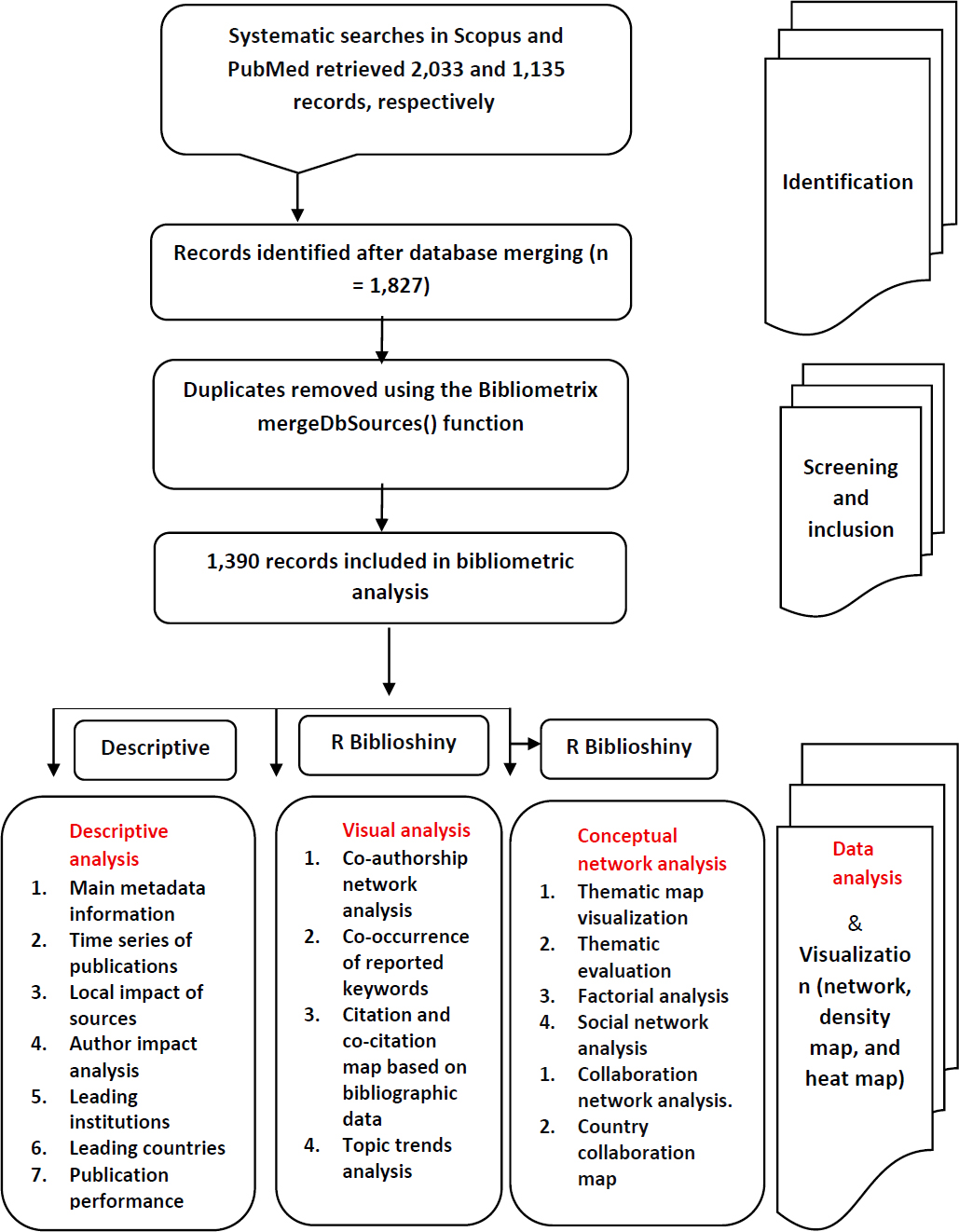
Flow diagram of global research on proprotein convertase subtilisin/kexin type 9 (PCSK9) inhibitors indexed in Scopus and PubMed.
2.3. Data Analysis
Descriptive statistics were used to summarize publication output, citations, authorship, sources, institutions, countries, and keywords. Bibliometric analyses were conducted using R software version 4.0.4 (R Foundation for Statistical Computing, Vienna, Austria) and the bibliometrix package [14]. Collaboration patterns among authors, countries, organizations, and keywords were analyzed and visualized. The Hirsch index (h-index) and generalized g-index were used as author- and source-level impact indicators. Spearman correlation coefficients were calculated using GraphPad Prism for Windows version 11.0.0 (GraphPad Software, San Diego, CA, United States).
3. RESULTS
3.1. Basic Characteristics of Data
A total of 1,390 documents on PCSK9 inhibitors were published between 1994 and 2024. These documents were sourced from 495 journals and other scholarly outlets, reflecting broad dissemination of research on this topic. The documents had a mean age of 5.02 years and a mean citation count of 37.09 citations per document, with 51,555 total citations overall. The dataset included 7,601 authors, 135 single-authored documents, and a mean of 9.91 co-authors per document. The international collaboration index was 1.871. Other characteristics of PCSK9 inhibitor research outputs are summarized in Table 1.
| Description | Results | Description | Results |
|---|---|---|---|
| Main information about data | - | Authors | - |
| Timespan | 1994-2024 | Authors | 7601 |
| Sources (Journals, Books, etc.) | 495 | Authors of single-authored docs | 89 |
| Documents | 1390 | Authors collaboration | - |
| Annual growth rate % | 1.32 | Single-authored docs | 135 |
| Document average age | 5.02 | Co-authors per Doc | 9.91 |
| Average citations per doc | 37.09 | International co-authorships % | 1.871 |
| Document contents | - | Document types | - |
| Keywords plus (ID) | 5594 | Article | 1021 |
| Author's keywords (DE) | 1678 | Clinical trial, comparative study, meta-analysis, & reviews | 369 |
TC: Total citations
3.2. The Global Overview of Publication Outputs
Publication volume on PCSK9 inhibitors reflects the evolving research trends and growth of the field over time. Figuer 2 illustrates annual publication volume and mean total citations per article from 1994 to 2024. The data show a marked and sustained increase in publication output beginning in 2013, peaking at approximately 200 articles per year by 2024. Despite this growth, mean citations per article showed considerable volatility, with an early peak around 2008 followed by a subsequent decline. No significant correlation was observed between annual publication volume and mean total citations (TC) per article (r = 0.059, P = 0.832).
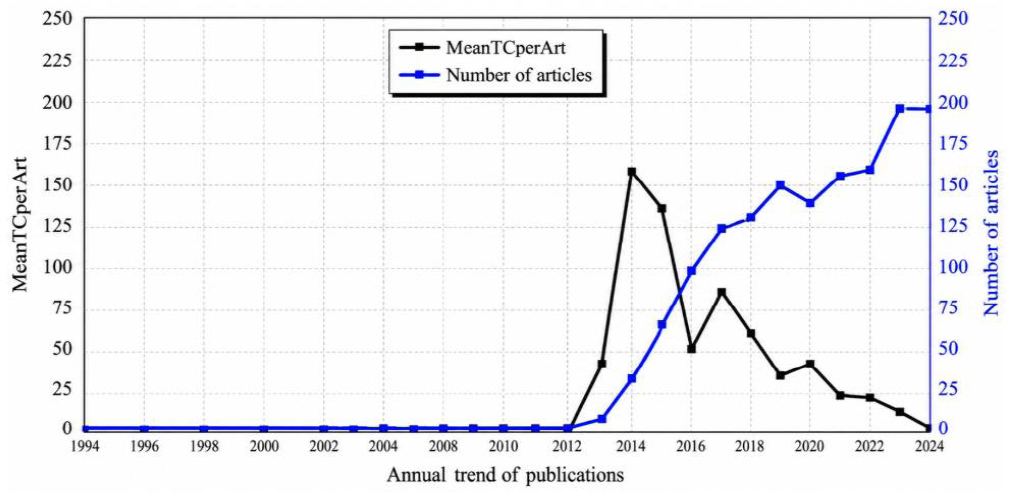
Annual publication output and mean total citations per article for PCSK9 inhibitor research from 1994 to 2024.
3.3. Highly Cited Documents on Global PCSK9 Inhibitors
The most-cited PCSK9 inhibitor documents identified in the bibliometric dataset are ranked in Table 2. The FOURIER trial had the highest citation score (TNC = 4,568), followed by the ODYSSEY OUTCOMES trial (TNC = 2,590). Pivotal inclisiran/ORION publications were also highly cited, accumulating 1,045 and 821 citations, respectively, indicating the emerging bibliometric visibility of RNA-based therapeutic approaches. Specialized evolocumab studies addressing familial hypercholesterolemia, including RUTHERFORD-2 and TESLA Part B, secured 672 and 649 citations, respectively, while the FOURIER peripheral artery disease subgroup analysis reached 628 citations. Overall, these findings show the dominance of monoclonal antibody outcome trials, alongside growing citation visibility for RNA-based PCSK9-targeted therapies.
| Rank | Paper | TNC |
|---|---|---|
| 1 | Sabatine MS, Giugliano RP, Keech AC, et al. Evolocumab and clinical outcomes in patients with cardiovascular disease (FOURIER). N Engl J Med. 2017;376(18):1713-1722. doi:10.1056/NEJMoa1615664. | 4568 |
| 2 | Schwartz GG, Steg PG, Szarek M, et al. Alirocumab and cardiovascular outcomes after acute coronary syndrome (ODYSSEY OUTCOMES). N Engl J Med. 2018;379(22):2097-2107. doi:10.1056/NEJMoa1801174. | 2590 |
| 3 | Robinson JG, Farnier M, Krempf M, et al. Efficacy and safety of alirocumab in reducing lipids and cardiovascular events (ODYSSEY LONG TERM). N Engl J Med. 2015;372(16):1489-1499. doi:10.1056/NEJMoa1501031. | 1854 |
| 4 | Sabatine MS, Giugliano RP, Wiviott SD, et al. Efficacy and safety of evolocumab in reducing lipids and cardiovascular events (OSLER-1/OSLER-2). N Engl J Med. 2015;372(16):1500-1509. doi:10.1056/NEJMoa1500858. | 1459 |
| 5 | Ray KK, Wright RS, Kallend D, et al. Two phase 3 trials of inclisiran in patients with elevated LDL cholesterol (ORION-10/ORION-11). N Engl J Med. 2020;382(16):1507-1519. doi:10.1056/NEJMoa1912387. | 1045 |
| 6 | Nicholls SJ, Puri R, Anderson T, et al. Effect of evolocumab on progression of coronary disease in statin-treated patients: the GLAGOV randomized clinical trial (GLAGOV). JAMA. 2016;316(22):2373-2384. doi:10.1001/jama.2016.16951. | 933 |
| 7 | Ray KK, Landmesser U, Leiter LA, et al. Inclisiran in patients at high cardiovascular risk with elevated LDL cholesterol (ORION-1). N Engl J Med. 2017;376(15):1430-1440. doi:10.1056/NEJMoa1615758. | 821 |
| 8 | Raal FJ, Stein EA, Dufour R, et al. PCSK9 inhibition with evolocumab (AMG 145) in heterozygous familial hypercholesterolaemia: a randomised, double-blind, placebo-controlled trial (RUTHERFORD-2). Lancet. 2015;385(9965):331-340. doi:10.1016/S0140-6736(14)61399-4. | 672 |
| 9 | Raal FJ, Honarpour N, Blom DJ, et al. Inhibition of PCSK9 with evolocumab in homozygous familial hypercholesterolaemia: a randomised, double-blind, placebo- controlled trial (TESLA Part B). Lancet. 2015;385(9965):341-350. doi:10.1016/S0140-6736(14)61374-X. | 649 |
| 10 | Bonaca MP, Nault P, Giugliano RP, et al. Low-density lipoprotein cholesterol lowering with evolocumab and outcomes in patients with peripheral artery disease: insights from the FOURIER trial (FOURIER PAD analysis). Circulation. 2018;137(4):338-350. doi:10.1161/CIRCULATIONAHA.117.032235. | 628 |
Abbreviations: TNC: total number of citations. Papers are ranked by citation count within the bibliometric dataset. Established trial or programme names are shown in parentheses.
Notably, no Clustered Regularly Interspaced Short Palindromic Repeats (CRISPR)-based gene-editing trials appeared in the top-cited list, suggesting that gene-editing approaches remain less visible in the clinical-trial-dominated PCSK9 inhibitor literature captured in this dataset.
3.4. Authorship Analysis
A total of 7,601 authors contributed to global PCSK9 inhibitor-associated publications. Wasserman S had the highest h-index (34), followed by Pordy R, who had 63 publications and an h-index of 32 (Table 3). Significant correlations were observed between the number of articles published per author and total citations (r = 0.222, P < 0.001), h-index (r = 0.918, P < 0.001), and generalized g-index (r = 0.2202, P < 0.001).
| Author | h-index | g-index | TNC | TNP |
|---|---|---|---|---|
| Wasserman S | 34 | 51 | 14430 | 51 |
| Pordy R | 32 | 63 | 9821 | 63 |
| Sabatine M | 31 | 49 | 11439 | 49 |
| Giugliano R | 30 | 50 | 11217 | 50 |
| Somaratne R | 28 | 41 | 11707 | 41 |
| Schwartz G | 27 | 56 | 5816 | 56 |
| Raal F | 26 | 48 | 9022 | 48 |
| Ray K | 26 | 54 | 7712 | 54 |
| Baccara-Dinet M | 25 | 46 | 3227 | 46 |
| Jukema J | 25 | 44 | 10570 | 44 |
Abbreviations: TNC: total number of citations; TNP: total number of publications; h-index: Hirsch index; g-index: generalized g-index. These indicators were calculated at the author level from the included Scopus and PubMed records.
3.5. Document Source and Citation Analysis
Global PCSK9 inhibitor-associated publications appeared in 495 sources. The Journal of Clinical Lipidology led the field, contributing 72 publications that collectively received 1,862 citations (Table 4). Significant correlations were observed between the number of articles and h-index (r = 0.9078, P < 0.001), total citations (r = 0.648, P < 0.001), and generalized g-index (r = 0.961, P < 0.001).
| Source (n=495) | h-index | g-index | TNC | TNP |
|---|---|---|---|---|
| Journal of Clinical Lipidology | 22 | 41 | 1862 | 72 |
| Journal of the American College of Cardiology | 25 | 36 | 3854 | 36 |
| European Heart Journal | 22 | 30 | 2912 | 30 |
| Circulation | 22 | 27 | 3019 | 27 |
| European Journal of Preventive Cardiology | 12 | 23 | 535 | 25 |
| Journal of the American Heart Association | 16 | 23 | 873 | 23 |
| Atherosclerosis | 13 | 21 | 688 | 21 |
| American Journal of Cardiology | 12 | 17 | 671 | 17 |
| Clinica e Investigation en Arteriosclerosis | 4 | 9 | 86 | 17 |
| Frontiers In Cardiovascular Medicine | 4 | 6 | 52 | 15 |
Abbreviations: TNC: total number of citations; TNP: total number of publications; h-index: Hirsch index; g-index: generalized g-index.
3.6. Analysis of Corresponding Authors' Countries
Based on Scopus and PubMed data, PCSK9 inhibitor research has been conducted in 52 regions globally. The United States led output with 343 published articles, followed by China with 167 and Italy with 88 (Table 5). The United States also dominated citation impact, with 28,793 citations, far exceeding the United Kingdom (3,694) and the Netherlands (2,011). This citation gap reflects differences in research output and underscores the central role of the United States in generating high-impact, clinically transformative studies, including pioneering clinical trials and fundamental mechanistic discoveries that have shaped the global PCSK9 research agenda. The correlation analysis suggests that PCSK9 inhibitor research output was driven mainly by domestic research activity, particularly in highly productive countries, such as the United States, with international collaboration contributing less to overall publication volume.
| Country (N=52) | Corresponding Author's Countries | Most Cited Countries | ||||||
|---|---|---|---|---|---|---|---|---|
| Articles | Articles % | SCP | MCP | MCP % | Country | TNC | AAC | |
| USA | 343 | 24.7 | 343 | 0.0 | 0.0 | USA | 28793 | 83.90 |
| China | 167 | 12 | 167 | 0.0 | 0.0 | United Kingdom | 3694 | 80.30 |
| Italy | 88 | 6.3 | 88 | 0.0 | 0.0 | Netherlands | 2011 | 67.00 |
| Spain | 61 | 4.4 | 61 | 0.0 | 0.0 | Australia | 1693 | 56.40 |
| Japan | 46 | 3.3 | 46 | 0.0 | 0.0 | South Africa | 1659 | 97.60 |
| United Kingdom | 46 | 3.3 | 46 | 0.0 | 0.0 | Italy | 1367 | 15.50 |
| France | 42 | 3.0 | 42 | 0.0 | 0.0 | China | 1223 | 7.30 |
| Germany | 42 | 3.0 | 42 | 0.0 | 0.0 | France | 1183 | 28.20 |
| Canada | 38 | 2.7 | 37 | 1.0 | 2.6 | Japan | 972 | 21.10 |
| Australia | 30 | 2.2 | 30 | 0.0 | 0.0 | Canada | 955 | 25.10 |
Abbreviations: AAC: Average Article Citations; TNP: Total Number of Publications; SCP: Single Country Publications; MCP: Multiple Country Publications. TNC: Total Number of Citations.
A near-perfect correlation between the number of articles per country and single-country publications (SCP; r = 1.000, P < 0.001) indicates that research productivity is overwhelmingly driven by national efforts. This suggests that most countries conducting PCSK9 research possess the infrastructure and expertise to advance studies independently without extensive external partnerships. Conversely, the weak and non-significant correlation between articles per country and multiple-country publications (MCP; r = 0.224, P = 0.1103) implies that international collaborations remain limited and niche-driven rather than foundational to productivity. Author-level collaboration networks are presented in Fig. (3A).
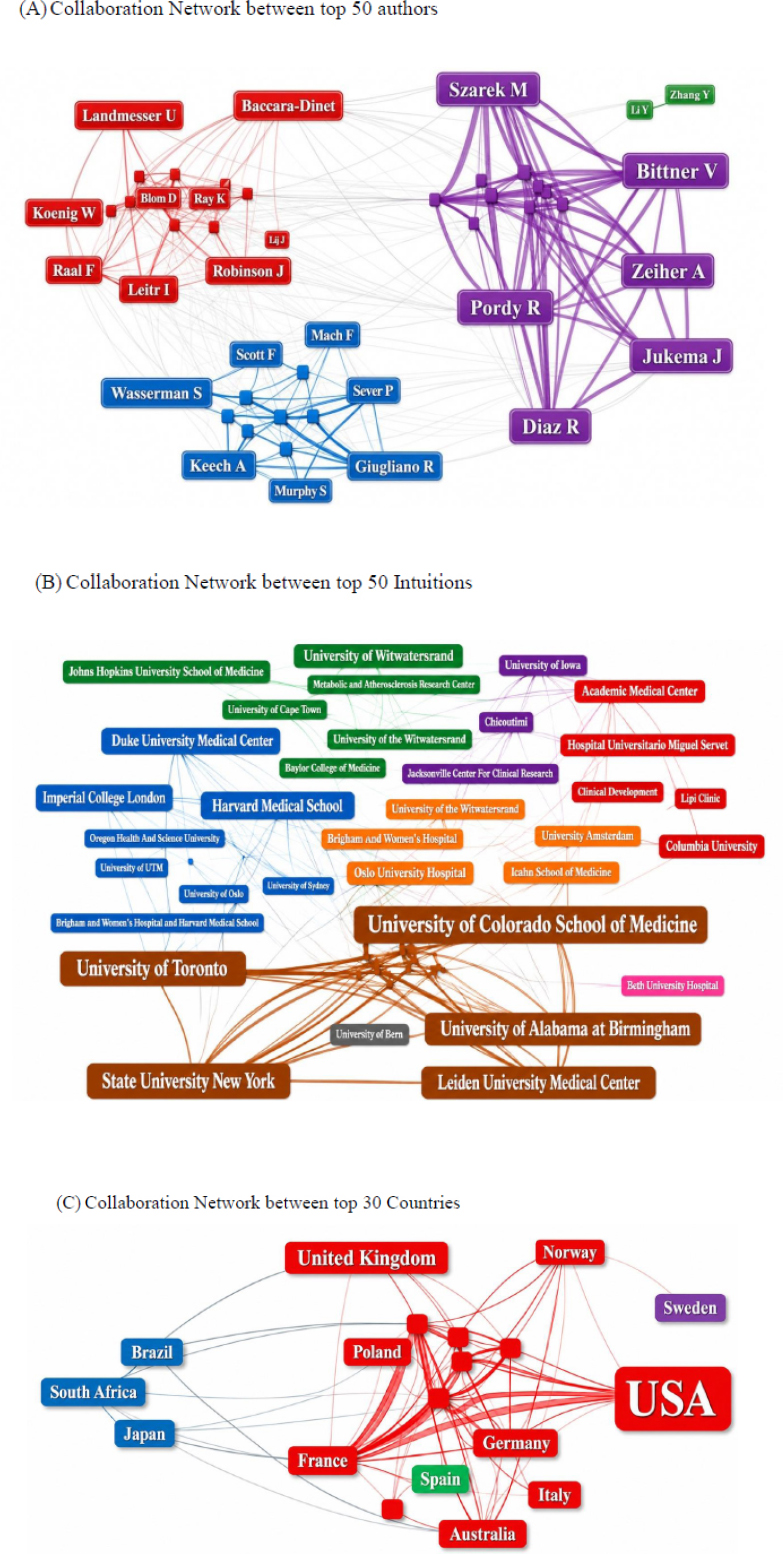
Collaboration network analysis among the top 50 authors (A), top 50 institutions (B), and top 30 countries (C) contributing to global PCSK9 inhibitor research.
3.7. Collaboration Network Analysis
International collaboration networks were analyzed for the top authors, institutions, and countries.
Collaboration network analysis of the top 50 authors revealed four distinct clusters. Figure 3A shows specialized yet interconnected groups within the PCSK9 inhibitor research community. Prominent authors, including Landmesser, Raal, Koenig, and Wasserman, were central figures within these collaborative networks. This structure highlights established patterns of partnership and knowledge exchange among leading experts in the field.
Figure 3B presents the collaboration network among the top 50 institutions contributing to global PCSK9 inhibitor research. The network is organized into eight distinct clusters, each representing a collaborative consortium. Cluster 1 includes Academic Medical Center, Clinical Development, Lipid Clinic, Columbia University, and Hospital Universitario Miguel Servet. Cluster 2, the largest and most diverse cluster, includes leading institutions from the United States, the United Kingdom, Australia, and Europe, such as Harvard Medical School, Mayo Clinic, Duke University, Imperial College London, the University of Sydney, the University of Oslo, and the University of Ulm. Cluster 3 includes the University of Cape Town, Baylor College of Medicine, Johns Hopkins University School of Medicine, the University of Western Australia, the University of the Witwatersrand, and the Metabolic and Atherosclerosis Research Center. Cluster 4 includes the University of Iowa and the Jacksonville Center for Clinical Research, Chicoutimi. Cluster 5 includes Oslo University Hospital, the University of Amsterdam, the University of the Witwatersrand, the Icahn School of Medicine at Mount Sinai, and Brigham and Women's Hospital. Cluster 6 includes the University of Toronto, University of Colorado School of Medicine, Leiden University Medical Center, Imperial College, University of Alabama at Birmingham, University of Alberta, State University of New York, Institute Cardiovascular de Rosario, Goethe University, Stanford University, Université de Paris, University of Kansas Medical Center, Netherlands Heart Institute, Auckland City Hospital, and University Medical Center Ljubljana. Cluster 7 includes Bern University Hospital, and Cluster 8 contains the University of Bern. These clusters suggest growing institutional cooperation in PCSK9 inhibitor research. Core institutions, including Harvard Medical School, Imperial College London, and Academic Medical Center, functioned as central hubs and highlight the key academic centers driving collaboration in this field.
Figure 3C shows the international collaboration network among the top 30 countries in PCSK9 inhibitor research. The analysis identified four main clusters. The United States, Italy, and the United Kingdom formed the largest and most connected group, whereas Japan, South Africa, and Brazil formed a separate cluster, indicating regional collaboration patterns. These results suggest that international partnerships remain concentrated within specific geographic and economic regions.
Keyword Plus terms are generated from the titles of cited references. LDL-C, low-density lipoprotein cholesterol; PCSK9, proprotein convertase subtilisin/kexin type 9
3.8. Word Cloud of the Top 100 Authors’ Keywords and Keyword Plus Occurrences
Figure 4A displays a word cloud of the top 100 authors' keywords used in global PCSK9 inhibitor research. The most frequent terms include “evolocumab,” “alirocumab,” “PCSK9,” “PCSK9 inhibitors,” “hypercholesterolemia,” “low-density lipoprotein cholesterol,” “PCSK9 inhibitor,” and “familial hypercholesterolemia.” This visual analysis highlights central clinical and pharmacological themes within the field. Keyword Plus refers to words or phrases generated from the titles of cited references. Figure 4B shows the Keyword Plus word cloud, which highlights broader related themes, such as lipid metabolism, cardiovascular risk, cholesterol lowering, clinical trials, and treatment outcomes. Together, Fig. (4A and B) indicate that PCSK9 inhibitor research is primarily focused on LDL-C reduction, monoclonal antibody therapies, hypercholesterolemia, and cardiovascular outcomes.
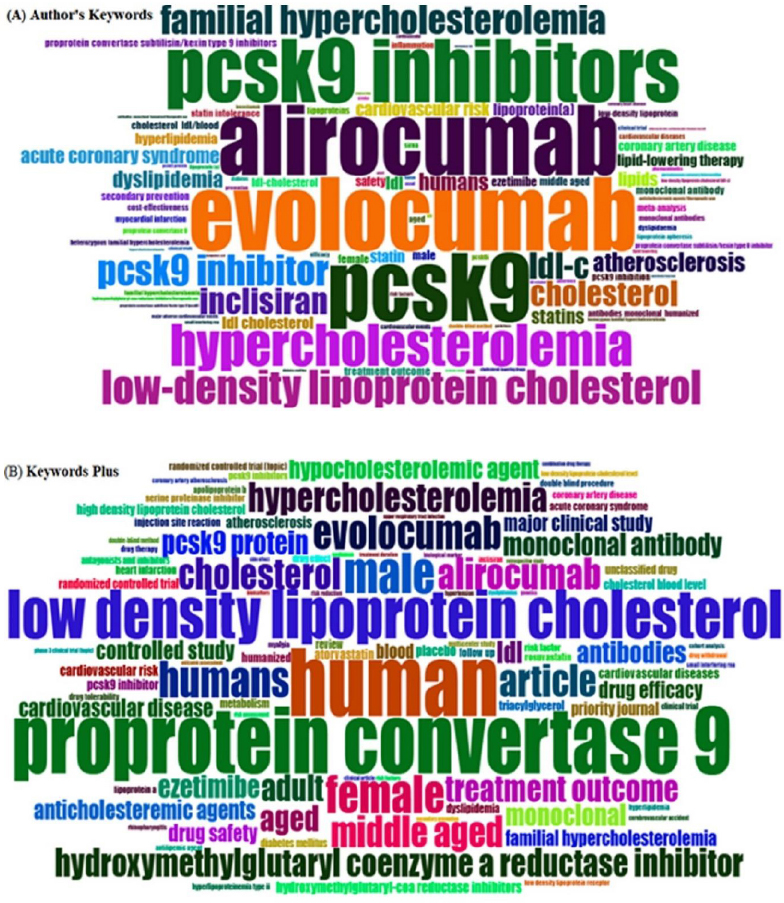
Word clouds of the top 100 most frequent authors’ keywords (A) and Keyword Plus terms (B) in global PCSK9 inhibitor publications.
3.9. Thematic Evolution of Keyword Plus Terms, 1994-2024
RStudio (Posit, PBC, Boston, MA, United States) and the bibliometrix package were used to analyze PCSK9 inhibitor publications indexed in Scopus and PubMed. Thematic maps were interpreted according to the standard quadrants shown in Fig. (5A-D): emerging or declining themes, basic themes, motor themes, and niche themes. Motor themes represent well-developed and central topics in the field, whereas niche themes represent specialized but relatively isolated topics in PCSK9 inhibitor research.
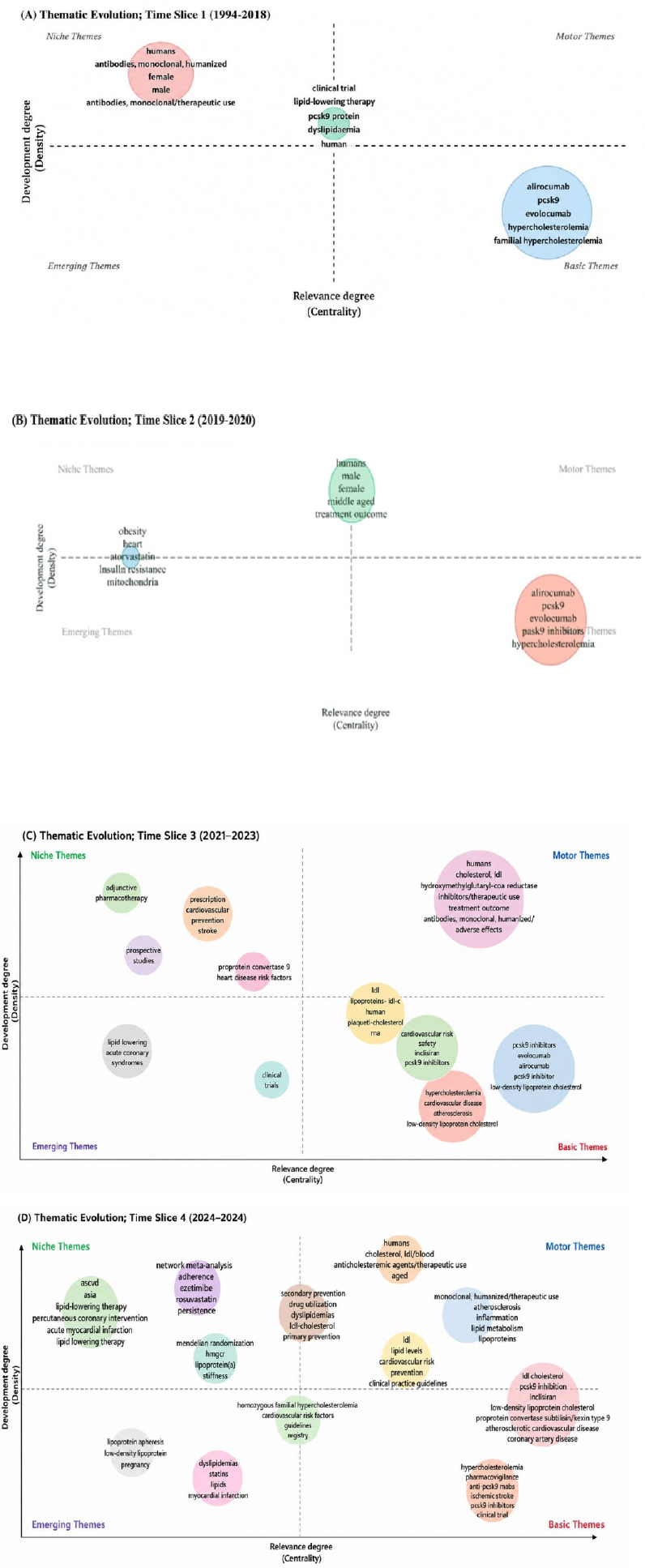
Thematic evolution of Keyword Plus terms across four periods: 1994-2018 (A), 2019-2020 (B), 2021-2023 (C), and 2024 (D).
Figure 5A, Thematic Evolution: Time Slice 1 (1994-2018), presents research themes by density and centrality. In this period, clinical trials, the PCSK9 protein, and hypercholesterolemia emerged as established motor themes, representing well-developed and influential research clusters. Broader topics, such as human studies and lipid-lowering therapy, were identified as foundational or emerging themes, highlighting the field's shift toward targeted PCSK9 interventions.
Figure 5B presents “alirocumab,” “PCSK9,” “evolocumab,” “PCSK9 inhibitors,” and “hypercholesterolemia” as basic themes. These topics are central to the field and represent the core terminology of PCSK9 inhibitor research.
Figure 5C presents thematic evolution during Time Slice 3 (2021-2023) and reveals several key developments. The terms “lipid lowering” and “acute coronary syndromes” appear in the emerging themes quadrant, reflecting a shift in research focus toward clinical outcomes and patient groups.
Figure 5D highlights “lipoprotein,” “low-density lipoprotein,” and “pregnancy” as emerging themes in 2024. This pattern reflects a shift toward research on specialized metabolic contexts and specific patient groups. The appearance of “pregnancy” suggests increasing interest in the safety and effectiveness of PCSK9 inhibitors in maternal and gestational cardiovascular health.
3.10. Factorial Analysis using Conceptual Structure Maps
Figure 6 maps key terms from PCSK9 inhibitor research according to their conceptual structure.
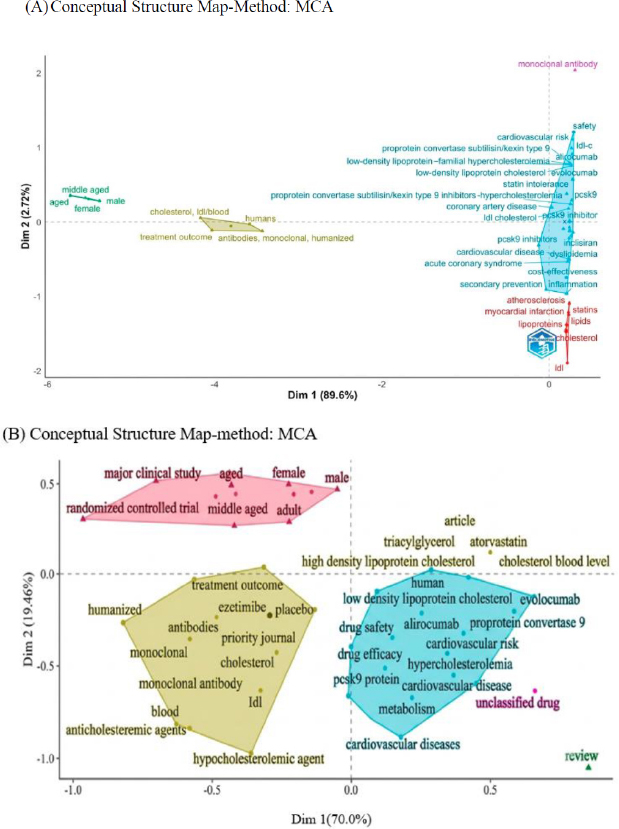
Factorial analysis using conceptual structure maps generated by multiple correspondence analysis (MCA): authors’ keyword associations (A) and Keywords Plus terms (B).
Based on Dimension 1 and 2, the analysis suggests that the field's themes are broadly interconnected rather than strongly separated when using the R-based science-mapping workflow [14].
The terms “monoclonal antibody” and “safety” had the highest values on Dimension 2, indicating distinct conceptual positioning. In contrast, terms, such as “PCSK9 inhibitor,” “inclisiran,” “cardiovascular disease,” and “acute coronary syndrome,” aligned closely along Dimension 1, reflecting their central and interrelated roles in the research landscape. Terms, such as “cost-effective” and “inflammation” also appeared, highlighting emerging or niche thematic directions (Fig. 6A).
Figure 6B presents a conceptual structure map generated through multiple correspondence analysis (MCA), organizing Keywords Plus terms into distinct conceptual clusters. The analysis revealed several coherent thematic groupings. The first cluster relates to clinical trial design and includes terms, such as “randomized controlled trial” and “placebo.” A second cluster relates to patient and study demographics, including “middle aged,” “adult,” “male,” and “female.” Another cluster covers lipid metabolism and biomarkers, including “low-density lipoprotein cholesterol,” “cholesterol blood level,” and “triacylglycerol.” Core pharmacological topics form a closely related cluster that includes “PCSK9 protein,” “monoclonal antibody,” “alirocumab,” and “hypercholesterolemia.” Terms, such as “cardiovascular disease” and “cardiovascular risk,” are positioned close to these clusters, indicating their relevance and direct association with the main research themes identified in the analysis.
4. DISCUSSION
This comprehensive cross-database analysis of Scopus and PubMed (1994-2024; n = 1,390) provides the first bibliometric mapping of PCSK9 inhibitor research that extends the translational progression from mechanistic discovery to recent clinical and modality innovations. Unlike prior Web of Science-only studies covering 2007-2022 (n = 1,072) [10] and 2007-2023 (n = 1,812) [10, 11], the combined Scopus and PubMed approach captured earlier mechanistic research [15] and altered the apparent institutional and geographic structure of the field.
Although our principal findings are consistent with previous Web of Science-based analyses regarding the post-2013 shift toward trial- and outcome-focused research, important analytic differences alter the perceived chronology and structure of the field. Luo et al. used CiteSpace and reported US/UK/Canada leadership and trial-driven clusters [10], whereas Lai et al. applied VOSviewer and CiteSpace and identified inclisiran among emergent hotspots [11].
The sharp increase in publications after 2013 should not be interpreted merely as field expansion but rather as a trial-driven reorientation of PCSK9 inhibitor research. This inflection coincides with the emergence of large cardiovascular outcome trials, which redirected research priorities from mechanistic discovery toward clinical validation, guideline relevance, and health-system implementation. Importantly, the absence of a significant correlation between publication volume and mean citation impact suggests that increased output did not proportionally enhance per-article influence, indicating maturation rather than diversification of the field.
Our Scopus and PubMed search recovered earlier mechanistic work that may have been missed by Web of Science (WoS) searches beginning in 2007. It also increased the representation of clinical and regional journals, including 167 publications from China, representing 12% of the 1,390 included records. In addition, full-count VOSviewer maps and R-based thematic evolution analysis identified institutional bridges and eight collaboration clusters that were less apparent in WoS-only analyses. These findings show that methodological choices, including timespan, indexing coverage, query design, and analytical workflow, can shape the perceived structure of the field and influence which researchers, journals, and regions are represented in bibliometric outputs [10, 11]. Taken together, these findings underscore the importance of database choice for bibliometric validity and provide a more policy-relevant baseline for future guideline development and funding priorities.
Network mapping identified eight persistent collaboration clusters and an international collaboration index of 1.87, showing that a small number of academic hubs (for example, Harvard Medical School, Academic Medical Centre, and the University of Toronto) acted as bridges linking early discovery with large outcome trials (Fig. 3B, C). The United States accounted for 343/1,390 (24.7%) of corresponding-author articles, and the top 10 countries contributed ≈65% of corresponding-author outputs (Table 5), underlining clear geographic concentration.
4.1. From Landmark Trials to Shifting Research Priorities
Our time-series and keyword-trajectory analyses identify a rapid expansion in publications after 2013 that reflects the prominence of highly cited outcome trials, including FOURIER, ODYSSEY OUTCOMES, and phase 3 inclisiran studies (Table 2) [7-9]. These landmark studies demonstrated clinically meaningful LDL-C reduction and cardiovascular risk reduction, triggering a measurable redirection of publications away from mechanistic exploration toward outcomes research, guideline integration, and economic evaluation [4, 16]. Recent outputs accelerated (approximately 200 papers anticipated in 2024, representing approximately 14.4% of the corpus), and citation activity increased steeply in the mid-2010s; these transitions were followed by a clear reorientation of keyword prominence from mechanistic descriptors toward trial/outcome language (top keywords: LDL-C, evolocumab, alirocumab, and treatment outcome) (Figs. 2-5; Table 2). This study describes this pattern as trial-associated and time-linked, because we did not perform interrupted-time-series causal testing in the current analysis. However, this volumetric expansion in output did not translate into higher per-article citation impact: no significant correlation was found between the number of publications and the mean total citations per article (P = 0.832), indicating that a higher volume of output alone did not enhance the average impact of individual articles.
Despite this trial-triggered drive, the international collaboration rate (1.87) remained modest. Trial-sponsoring institutions in high-income countries continued to dominate authorship and citation networks, whereas LMIC contributions were relatively sparse. This pattern is reflected in country-level statistics: the number of articles per country correlated perfectly with single-country publications (r = 1.000, P < 0.001) but showed only a weak, non-significant association with multiple-country publications (r = 0.224, P = 0.1103), consistent with limited multi-country collaboration. Given the high cost and delivery challenges of PCSK9 inhibitors, this imbalance risks producing evidence that is poorly generalizable to regions bearing the greatest cardiovascular burden. Implementation has also been constrained by availability, payer policy, list price, prior authorization, and variable national reimbursement, which have limited PCSK9 inhibitor use to narrow high-risk groups and driven health economics, access-barrier, and implementation research [16-22].
4.2. Emerging RNA Therapeutics and Genome-Editing Approaches
Monoclonal antibody trials remain the dominant, mature evidence base. However, RNA-directed therapies, such as inclisiran, have rapidly gained thematic prominence and robust LDL-C lowering in phase 3 trials (ORION reports TNC = 1,045 and 821) [9], signaling movement from early mechanistic interest toward mid-stage clinical adoption. At the author level, productivity correlated strongly with impact metrics: the number of articles per author correlated significantly with total citations (r = 0.222, P < 0.001), with h-index (r = 0.918, P < 0.001), and with g-index (r = 0.2202, P < 0.001), indicating that more productive authors also have higher citation impact and established reputations. Keyword hotspots, such as inclisiran, indicate growing visibility, although relative citation maturity remains lower for these modalities, consistent with their earlier translational stage [9].
CRISPR/gene-editing approaches were not detected as hotspots in the dataset and do not appear among top-cited clinical publications, suggesting they remain at preclinical or early translational stages and are therefore outside the scope of the clinical-trial-dominated literature captured here.
4.3. Analytical Exploration of LMIC Underrepresentation
The underrepresentation of LMICs in PCSK9 inhibitor research goes beyond a simple publication gap; it reflects deeper structural inequities. Most studies are led by high-income countries with access to industry-sponsored trials, advanced research infrastructure, and early regulatory approvals. This concentration limits the applicability of evidence and guideline recommendations in regions where cardiovascular disease burden is high but access to PCSK9 inhibitors is restricted by cost and reimbursement barriers. Collaboration between countries remains limited, often leaving LMICs on the periphery rather than fully integrated into the research landscape.
Although integrating Scopus and PubMed improved coverage compared with single-database approaches, some regional indexes and non-indexed journals were not captured, meaning publications from LMICs may still be underrepresented. Reliance on citation-based metrics also tends to favor older, well-established outcome trials and may underrepresent emerging modalities, such as RNA-based therapies. While keyword and thematic analyses describe research visibility and evolution, they do not assess implementation outcomes, such as affordability, health-system feasibility, or treatment utilization in routine clinical care.
Importantly, while the bibliometric methods do not measure patient-level rates directly, publication trends mirror clinical milestones; publication activity rose markedly after 2013, following pivotal outcome trials, such as FOURIER and ODYSSEY OUTCOMES, which confirmed cardiovascular benefit beyond LDL-C reduction [7, 8]. However, real-world utilization has remained modest, largely due to non-clinical barriers including high drug costs, restrictive reimbursement policies, and prior-authorization requirements [17-21]. National and multinational observational reports also show persistent gaps in LDL-C control despite availability of high-intensity statins and add-on therapies [3, 17, 20-22].
Geographic patterns mirror access disparities, with North America and Western Europe leading research output, while Asia, Africa, and Latin America lag despite comparable disease burden. These findings highlight the need for inclusive trial designs, regional registry-based studies, and broader data integration to support equitable translation of PCSK9 inhibitor therapy into global cardiovascular care.
CONCLUSION
This bibliometric analysis provides a comprehensive assessment of the evolution of PCSK9 inhibitor research. The field experienced a major post-2013 shift, largely driven by cardiovascular outcome trials that validated clinical benefit beyond LDL-C reduction. The research landscape was dominated by high-income countries, particularly the United States and its leading academic institutions. Although monoclonal antibodies form the established and highly cited center of the literature, newer RNA-based therapies, such as inclisiran, are also gaining thematic visibility. International collaboration exists, but it remains moderate, with limited participation from low- and middle-income countries. Beyond mapping research output, this study highlights how bibliometric methodology shapes scientific narratives and may influence research prioritization, funding strategies, and equitable translation of evidence into cardiovascular care.
IMPLICATIONS
This bibliometric analysis goes beyond describing publication growth and citation performance; it helps clarify how scientific evidence on PCSK9 inhibitors has translated into clinical practice and where meaningful gaps persist. The sharp rise in publications after 2013 coincides with the release of major cardiovascular outcome trials demonstrating that PCSK9 inhibitors reduce not only LDL-C levels but also major adverse cardiovascular events. This surge reflects a clear transition from early mechanistic research toward outcome validation, guideline integration, and implementation-oriented investigations.
Importantly, expanding scientific output has not translated into proportional clinical uptake. Real-world data from the post-trial era show that initiation of PCSK9 inhibitor therapy has increased gradually among patients with ASCVD and persistently elevated LDL-C, but overall treatment rates remain modest relative to the size of the eligible population. This implementation gap appears to stem less from doubts about efficacy and more from structural barriers, including high drug costs, reimbursement limitations, prior authorization requirements, and broader health-system constraints.
Empirical evidence supports this pattern. Analyses of large U.S. claims databases indicate that initiation rates among eligible ASCVD patients increased from approximately 0.05% in 2015 to about 2.5% by mid-2019, despite growing guideline endorsement and trial evidence [20]. Similarly, longitudinal electronic health record data show that new prescription rates rose from roughly 0.5% in 2015 to 3.3% in 2019, while treatment continuation improved substantially, from 18% to 60% over the same period [21]. Following manufacturer-initiated price reductions in 2018, patient out-of-pocket costs decreased and persistence improved in some settings, highlighting the decisive role of affordability in shaping clinical adoption [22]. Even with these improvements, however, the majority of eligible high-risk patients remain untreated in routine practice.
Geographic publication patterns observed in the analysis further suggest that clinical adoption likely differs across continents. The dominance of North America and Western Europe in research output corresponds to regions where regulatory approval, reimbursement pathways, and price negotiations occurred earlier and more extensively. In contrast, comparatively lower research output from parts of Asia, Africa, and Latin America may reflect delayed access, affordability challenges, and limited healthcare infrastructure, potentially translating into lower initiation rates despite substantial cardiovascular disease burden.
Taken together, these findings underscore the need to move beyond efficacy-focused research toward equitable implementation strategies. Future studies should integrate bibliometric trends with registry and claims-based utilization data to better quantify changes in treatment initiation over time and across regions. Strengthening multinational collaboration, particularly with greater involvement of low- and middle-income countries, will be essential to ensure that evidence generation, clinical adoption, and policy development align with global cardiovascular care needs rather than remaining concentrated in high-income settings.
FUTURE RECOMMENDATIONS
There is a clear need to ensure a balanced, sustainable, and operational future for PCSK9 research. To achieve this, several strategic actions should be considered. First, genuine global collaboration, particularly involving low- and middle-income countries, should be actively promoted to reduce research inequities and broaden perspectives. Second, similar studies should be expanded to include regional databases and standardized equity metrics to enable meaningful comparisons across settings.
Greater emphasis should also be placed on real-world effectiveness and implementation research across diverse healthcare systems, as this will better inform clinical and policy decisions. In parallel, further investigation of emerging therapies, including RNA-based agents, is warranted, with global accessibility and affordability considered from the earliest stages of development. Finally, strengthening data-sharing policies is essential to empower researchers from under-resourced institutions and to foster a more inclusive and collaborative research environment.
AUTHORS’ CONTRIBUTIONS
The authors confirm their contribution to the paper as follows: K.A. and K.W.: Funding acquisition was carried out; M.H., B.Y., R.A., A.A., and I.Z.: Material preparation and data collection were performed; M.H. and K.R.: Data analysis was conducted; K.B., K.A., and T.M.: The first draft of the manuscript was written. All authors reviewed the results and approved the final version of the manuscript.
LIST OF ABBREVIATIONS
| PCSK9 | = Proprotein convertase subtilisin/kexin type 9 |
| ASCVD | = Atherosclerotic cardiovascular disease |
| MeSH | = Medical Subject Headings |
| CSV | = Comma-separated values |
| TC | = Mean total citations |
| CRISPR | = Clustered Regularly Interspaced Short Palindromic Repeats |
AVAILABILITY OF DATA AND MATERIAL
The data of current study are available from corresponding authors, [K.O.A.] and [K.Al-B], on a reasonable request.
ACKNOWLEDGEMENTS
Declared none.